 Admin
Admin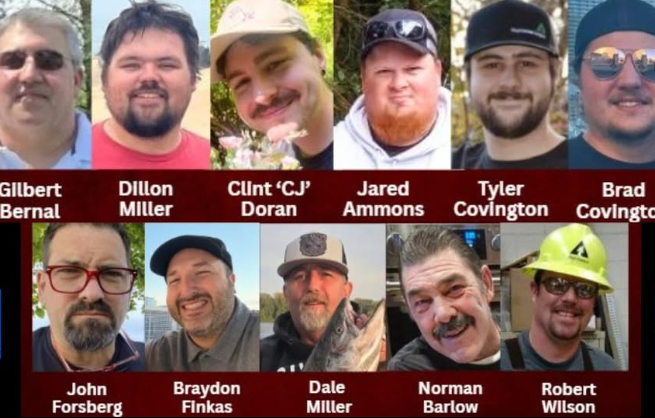
Officials have confirmed the identities of all 11 workers killed in the catastrophic chemical implosion at the Nippon Dynawave Packaging facility in Longview, Washington, bringing a devastating industrial disaster to its final and tragic accounting after the remains of all nine missing workers were located and identified following an extensive search and recovery operation at the destroyed facility.
The explosion, which occurred during a shift change at approximately 7:15 a.m. Tuesday at the plant located on Industrial Way in Longview, caused catastrophic structural damage throughout the facility and claimed the lives of eleven workers ranging in age from 26 to 58 years old — eleven fathers, sons, brothers, friends, and colleagues who left for work on a Tuesday morning and did not come home.
The eleven workers confirmed killed in the Nippon Dynawave Packaging explosion have been identified as 52-year-old Gilberto Bernard, 29-year-old Tyler Covington, 27-year-old Brad Covington, 48-year-old Robert Wilson, 54-year-old Dale Miller, 35-year-old Jared Ammons, 38-year-old Brayden Pincus, 26-year-old Clinton Duran, 51-year-old John Forsberg, 58-year-old Norman Burleigh, and Dillon Miller, whose age has not been released by authorities. According to Cowlitz 2 Fire and Rescue Chief Scott Goldstein, the rupture occurred during a shift change in an area of the facility containing administrative offices, operational workspaces, and employee break rooms — a location that would have been populated with workers at the moment of the explosion, contributing to the catastrophic death toll.
What Authorities Have Confirmed
The explosion occurred at approximately 7:15 a.m. on Tuesday at the Nippon Dynawave Packaging facility located on Industrial Way in Longview, Washington. According to Cowlitz 2 Fire and Rescue Chief Scott Goldstein, who has served as the primary public spokesperson for the emergency response operation, the rupture — described by officials as a chemical implosion — took place during a shift change, a period during which the number of workers present in the affected area of the facility would have been elevated as incoming and outgoing shift workers congregated in the administrative, operational, and break room spaces where the blast occurred.
The powerful implosion caused catastrophic structural damage throughout the Nippon Dynawave Packaging facility, creating conditions that made immediate search and rescue operations extraordinarily difficult and dangerous. Emergency responders from Cowlitz 2 Fire and Rescue and multiple additional agencies responded to the scene immediately following the explosion and worked for days under hazardous and technically demanding conditions to locate and recover the remains of all workers who were unaccounted for in the immediate aftermath of the blast.
Nine workers were initially reported missing following the explosion, with two deaths confirmed in the immediate aftermath of the incident. Following an extensive and painstaking search and recovery operation, officials confirmed that the remains of all nine missing workers had been located and identified, bringing the confirmed death toll to eleven. The Cowlitz County Medical Examiner’s Office has been involved in the identification of all victims, a process complicated by the catastrophic nature of the structural damage sustained by the facility during the implosion.
The Washington State Department of Labor and Industries, which has jurisdiction over workplace safety investigations in Washington State, has opened a full investigation into the circumstances that led to the explosion at the Nippon Dynawave Packaging facility. The federal Occupational Safety and Health Administration has also been notified and is involved in the investigation, consistent with federal requirements for industrial accidents resulting in multiple worker fatalities. The investigation is ongoing and is expected to take weeks to months to complete given the complexity of the evidence and the scope of the disaster.
The Eleven Workers Who Lost Their Lives
The human cost of the Nippon Dynawave Packaging explosion is measured most meaningfully not in structural damage assessments or regulatory findings but in the lives of the eleven men who went to work on a Tuesday morning and were killed in a moment of industrial catastrophe. Each of them was a person with a life, a family, and a future — and each of their deaths represents an immeasurable and irreplaceable loss.
Gilberto Bernard, 52 — A 52-year-old worker whose years of experience in the industrial sector were matched by the deep and lasting bonds he had built with colleagues and community members over the course of a working life dedicated to the hard and essential work of industrial manufacturing.
Tyler Covington, 29 — At 29 years old, Tyler Covington was a young man in the early stages of a working life full of promise. His death at such a young age is a loss of particular and devastating depth for a family that had every reason to expect decades more of his presence in their lives.
Brad Covington, 27 — Brad Covington, 27, shared a surname with Tyler Covington, and the nature of their relationship — whether as brothers, cousins, or fellow workers who shared a name — has not been confirmed by authorities at the time of this publication. At 27, Brad was among the youngest of the eleven victims, a young man whose life was taken at an age when the most significant chapters were still ahead of him.
Robert Wilson, 48 — Robert Wilson was 48 years old — a man in the middle of his working life, with the experience and the institutional knowledge that workers of his tenure bring to any operation and that cannot be quickly or easily replaced.
Dale Miller, 54 — Dale Miller, 54, was among the more senior members of the workforce killed in Tuesday’s explosion. In his mid-fifties, Dale was a man who had given decades of his working life to industrial labor and whose expertise and experience were a resource that his colleagues and his employer depended upon.
Jared Ammons, 35 — Jared Ammons was 35 years old — at the point in a career when a worker has accumulated enough experience to be genuinely valuable and still has enough working years ahead to make a sustained and significant contribution. His death at 35 is a loss that extends beyond his immediate family to the colleagues who worked alongside him and the community that knew him.
Brayden Pincus, 38 — Brayden Pincus, 38, was a man in the prime of his working and personal life. At 38, he was at an age when family, career, and community connections are often at their most developed and most meaningful — an age when loss lands with particular weight on the people left behind.
Clinton Duran, 26 — Clinton Duran was 26 years old — the second youngest of the eleven victims and a young man whose life had barely entered its adult chapters. The loss of a 26-year-old in an industrial accident is a tragedy of particular and resonant depth, representing not only the life that was lived but the much longer life that will now never unfold.
John Forsberg, 51 — John Forsberg, 51, was a worker of considerable experience and institutional knowledge whose presence in the Longview industrial community extended across decades of working life. His death leaves a void that those who knew him — professionally and personally — will feel for years to come.
Norman Burleigh, 58 — Norman Burleigh was 58 years old — among the oldest and most experienced of the eleven victims. At 58, he was approaching the later stages of a working career that had likely spanned decades and that had contributed substantially to the operations of the facilities and communities he had served.
Dillon Miller, age not released — Dillon Miller’s age has not been publicly released by authorities at the time of this publication. He is mourned alongside his ten colleagues as a member of a workforce that showed up on a Tuesday morning to do the essential work of industrial production and paid the ultimate price for doing so.
About Nippon Dynawave Packaging and the Longview Facility
Nippon Dynawave Packaging is an industrial paper and packaging manufacturing company operating the Longview, Washington facility on Industrial Way. The facility is part of the industrial corridor along the Columbia River that has been a cornerstone of the Longview regional economy for generations, providing manufacturing employment to hundreds of workers and serving as one of the foundational industrial employers in Cowlitz County.
Longview, Washington is a city of approximately 40,000 residents located along the Columbia River in Cowlitz County, situated roughly 45 miles north of Portland, Oregon. According to the United States Census Bureau, Longview was founded in the early 20th century as a planned industrial city and has maintained its identity as a center of industrial and manufacturing activity throughout its history. The city’s economy is deeply connected to the industrial facilities that line the Columbia River waterfront, and the workers employed at those facilities — including the eleven men killed at Nippon Dynawave Packaging — are central to the economic and social fabric of the community.
The Nippon Dynawave Packaging facility on Industrial Way is one of the major employers in the Longview area, and its workforce is deeply embedded in the community. The eleven workers killed in Tuesday’s explosion were not abstract employees of a corporate entity — they were neighbors, fathers, coaches, churchgoers, and community members whose daily participation in the life of Longview and the surrounding area made the city what it is.
Industrial Safety in Washington State and Across America
The explosion at the Nippon Dynawave Packaging facility in Longview is one of the deadliest industrial accidents in Washington State in recent memory, and it demands a reckoning with the state of industrial safety standards, regulatory enforcement, and worker protection across the American manufacturing sector.
According to the United States Bureau of Labor Statistics, approximately 5,000 workers are killed in workplace accidents across the United States every year, with industrial and manufacturing facilities accounting for a disproportionate share of fatal workplace incidents. Chemical-related incidents — including explosions, fires, and toxic releases — represent one of the most dangerous categories of industrial accident, capable of causing mass casualties in a matter of seconds when containment systems fail, pressure builds beyond structural tolerance, or chemical reactions occur under conditions that the facility’s safety systems were not designed to manage.
The federal Occupational Safety and Health Administration is the primary regulatory body responsible for enforcing workplace safety standards at industrial facilities across the United States. OSHA maintains a comprehensive set of standards governing the handling, storage, and processing of hazardous chemicals in industrial settings, including the Process Safety Management standard, which is specifically designed to prevent catastrophic releases of highly hazardous chemicals and which applies to facilities like the Nippon Dynawave Packaging plant that handle chemicals capable of causing large-scale industrial accidents.
The Washington State Department of Labor and Industries administers the state OSHA program in Washington, operating under a state plan approved by federal OSHA. Washington’s industrial safety standards are among the most comprehensive in the nation, and the agency has broad authority to investigate industrial accidents, issue citations, and impose penalties on employers whose violations of safety standards contribute to worker injuries and deaths.
The investigation into the Nippon Dynawave Packaging explosion will examine whether the facility was in compliance with all applicable state and federal safety standards at the time of the accident, whether any previous safety violations or concerns had been identified and addressed, and whether the design, maintenance, and operation of the facility’s chemical handling systems met the standards required to protect the workers who depended on those systems for their safety.
The Cowlitz County Community in Mourning
The death of eleven workers in a single industrial accident has shaken the Cowlitz County community in ways that will take months and years to fully process. In a community of approximately 40,000 residents, the loss of eleven members of the workforce in a single morning represents a collective trauma of extraordinary proportions — a grief that is simultaneously personal, for the families directly affected, and communal, for a city that knew these men and that understands with visceral clarity what their absence means.
Cowlitz 2 Fire and Rescue Chief Scott Goldstein and the emergency responders who worked at the Nippon Dynawave Packaging facility in the days following the explosion deserve the community’s deepest gratitude and recognition. Working in a structurally compromised facility, under the ongoing threat of secondary hazards, in conditions of profound physical and emotional difficulty, these first responders gave everything they had to the effort to locate and recover the remains of the nine missing workers. Their dedication and professionalism in the most demanding of circumstances reflects the highest standards of emergency response, and the Cowlitz County community is in their debt.
The broader Longview community — the neighbors, friends, and fellow community members of the eleven men killed at Nippon Dynawave Packaging — has rallied around the families left behind with the kind of immediate and sustained outpouring of support that characterizes communities that understand what it means to lose their own. Memorial gatherings, community vigils, and organized support efforts for the affected families have been organized across Longview and the surrounding area, reflecting a collective determination to honor the lives of the eleven men lost and to support the people who loved them through the most difficult time of their lives.
Worker Safety Advocacy: What Must Come Next
The deaths of eleven workers at the Nippon Dynawave Packaging facility demand more than grief and condolences — they demand action. The investigation into the cause of the explosion must be conducted with the full resources of the Washington State Department of Labor and Industries and federal OSHA, and its findings must be made public in full so that the industrial community, regulatory agencies, and the families of the victims can understand exactly what happened and what must change to prevent similar tragedies.
The United Steelworkers union, which represents workers in the paper and packaging manufacturing industry including many facilities along the Pacific Northwest’s industrial corridor, has long advocated for stronger enforcement of industrial safety standards and greater worker involvement in safety planning and hazard identification. The deaths at Nippon Dynawave Packaging will renew those calls with urgency and moral weight that demands a response from employers, regulators, and elected officials at the state and federal level.
According to the National Council for Occupational Safety and Health, the most effective industrial safety programs are those that treat workers as the primary experts on the hazards of their own workplaces and that create genuine channels for worker input, concern reporting, and participation in safety planning. When workers feel empowered to report safety concerns without fear of retaliation and when those concerns are taken seriously and addressed promptly by management, the likelihood of catastrophic industrial accidents is significantly reduced.
The families of the eleven men killed at Nippon Dynawave Packaging deserve to know that their loved ones’ deaths will produce meaningful change — that the regulatory findings, the legal proceedings, and the policy responses that follow will result in a safer industrial environment for the workers who come after them. That is the most meaningful tribute that the broader industrial community, the state of Washington, and the federal government can offer to the memory of Gilberto Bernard, Tyler Covington, Brad Covington, Robert Wilson, Dale Miller, Jared Ammons, Brayden Pincus, Clinton Duran, John Forsberg, Norman Burleigh, and Dillon Miller.
Grief Support Resources for the Longview Community
For members of the Longview community, Cowlitz County, and all those grieving the loss of the eleven workers killed in the Nippon Dynawave Packaging explosion, the following support resources are available:
- Crisis Text Line — Text HOME to 741741, available 24 hours a day, 7 days a week, free and confidential
- SAMHSA National Helpline — 1-800-662-4357, free, confidential, available around the clock for mental health and crisis support
- Washington State Department of Health — Mental Health — Statewide mental health resources and crisis support for Washington residents
- Cowlitz County Mental Health — Local mental health services and crisis support for Cowlitz County residents
- National Alliance on Mental Illness — Washington — Mental health support, grief resources, and crisis intervention for Washington State residents
- First Responder Support Network — Mental health resources specifically designed for first responders and emergency services workers who responded to the Nippon Dynawave Packaging facility
A Final Tribute to the Eleven Workers of Nippon Dynawave Packaging
Gilberto Bernard. Tyler Covington. Brad Covington. Robert Wilson. Dale Miller. Jared Ammons. Brayden Pincus. Clinton Duran. John Forsberg. Norman Burleigh. Dillon Miller.
Eleven names. Eleven lives. Eleven workers who left for work on a Tuesday morning and were killed in an explosion that should never have happened — in a facility that should have been safe, on a shift that should have ended with everyone going home to the people who loved them.
They ranged in age from 26 to 58 years old. They brought to work on Tuesday morning the accumulated experience, the professional knowledge, and the personal commitments that defined who they were as workers and as human beings. They were fathers and sons and brothers and friends. They were members of a community that is now incomplete without them, that is carrying a grief that will not quickly or easily resolve, and that deserves answers, accountability, and the assurance that what happened at the Nippon Dynawave Packaging facility on Industrial Way in Longview will never happen again.
EagleHub will continue to follow the Washington State Department of Labor and Industries investigation, the federal OSHA investigation, and all legal and regulatory proceedings related to the Nippon Dynawave Packaging explosion, and will provide updates as verified official information becomes available.
Rest in peace to all eleven workers of Nippon Dynawave Packaging. You are honored, you are mourned, and Longview — and the nation — will not forget you.
